2026 Student Loan Update: RAP explained in plain English

Right now, I still need to raise $230 to pay the remainder of their writer's fee. If you believe in trans storytelling, please donate here.
Friends, student loans are a hot mess.
Below, I tried to give you as many updates as possible in plain English.
I know this information can be really overwhelming, so I invite you to view this story on our website. Ghost has a very cool toggle feature that allows you to open and close sections by clicking on a small arrow to the right of the header text.
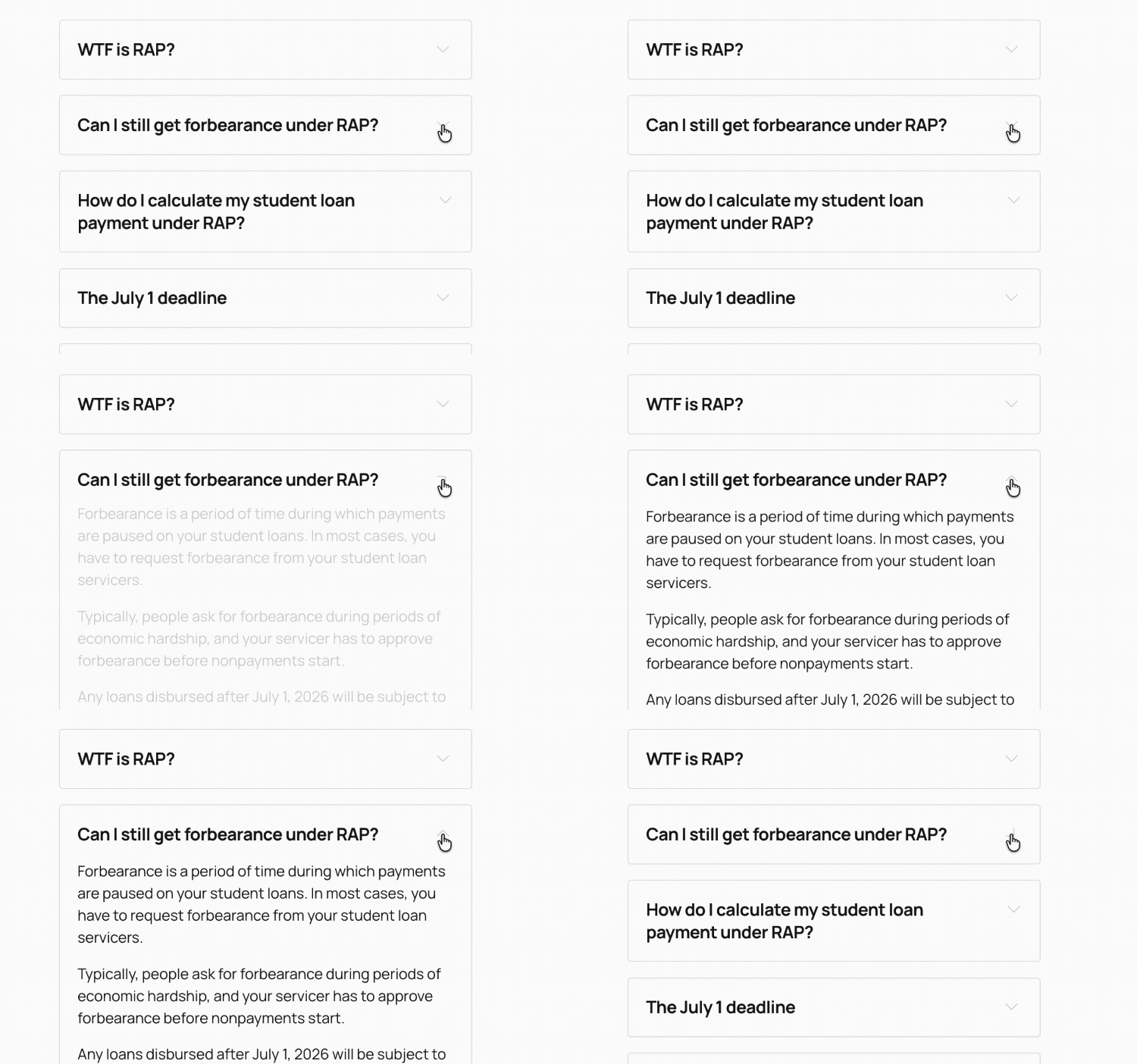
It’s really helpful to read one section at a time so you can digest the information that applies to you. Simply scroll to the top of this email and click "View in browser."
Debt strike updates
The Debt Collective is an organization that famously called for a debt strike, a period of time when people with student loans stop making payments altogether.
Given our circumstances under the Trump administration, the Debt Collective is not calling for a debt strike right now. They are encouraging borrowers to do what they can to avoid defaulting on their student loans.
On their September 15 Emergency SAVE Webinar, Julia Barnard said, "We typically don't recommend default because of how punitive the consequences are."
The Debt Collective offers the following resources:
- A monthly Zoom call for student loan borrowers who are considering default
- A Signal group for people navigating the Total and Permanent Disability Discharge (known as the TPD Discharge)
- A Signal group for people navigating the Public Service Loan Forgiveness Program (PSLF)
Get in touch with the Debt Collective here.
WTF is RAP?
The Repayment Assistance Program (RAP) is a program formed under Trump’s One Big Beautiful Bill Act.
The main difference between RAP and other plans: Until now, income-driven repayment plans are calculated based on your discretionary income. Based on the national federal poverty limits, the government calculates what they think you’ll need for your family size to get your discretionary income, then take 5, 10 or 15% of that number, depending on the plan.
But RAP is calculated based on your adjusted gross income (AGI), which can be found on line 11 of your tax return.
Here’s how your monthly payment will be calculated based on your AGI:
- $10,000 or less: $10 minimum payment per month
- $10,001 to $20,000: 1% of AGI
- $30,001 to $40,000: 2% of AGI
- $40,001 to $50,000: 4% of AGI
- $50,001 to $60,000: 5% of AGI
- $60,001 to $70,000: 6% of AGI
- $70,001 to $80,000: 7% of AGI
- $80,001 to $90,000: 8% of AGI
- $90,001 to $10,000: 9% of AGI
- $100,001 or more: 10% of AGI
Borrowers can deduct $50 per month per dependent.
(Source: Student Loan Planner)
Can I still get forbearance under RAP?
Forbearance is a period of time during which payments are paused on your student loans. In most cases, you have to request forbearance from your student loan servicers.
Typically, people ask for forbearance during periods of economic hardship, and your servicer has to approve forbearance before nonpayments start.
Any loans disbursed after July 1, 2026 will be subject to stricter forbearance rules. These borrowers are only allowed 9 months of forbearance within a 2-year period.
Anyone who borrowed student loans before July 1, 2026 will have the same rules: You can request up to 12 months of forbearance at a time during periods of financial hardship.
How do I calculate my student loan payment under RAP?
Use this calculator by EDCAP New York.
You’ll need to provide:
- Your total loan balance
- Annual interest rate, expressed as a percentage
- Adjusted Gross Income (AGI), line 11 on your tax return, form 1040
- Your household size
- Number of dependents
- State of residence
- Borrower type (whether you borrowed before or after 2014)
The Education Debt Consumer Assistance Program (EDCAP) is a program that helps New Yorkers navigate student loans. If you live in New York state, you can even call their hotline for free at 888-614-5004 and get some free guidance on your specific loans.
The July 1 deadline
For borrowers on the SAVE Plan forbearance: Around July 1, you’ll receive a notice asking you to select a new repayment plan. Once you receive the notice, you’ll have 90 days to select your new plan. If you don’t select a plan within 90 days, you’ll automatically be transferred into the Tiered Standard Repayment plan, which usually has higher monthly payments.
For people with Parent PLUS loans: Parent PLUS loans are loans borrowed by parents to support their child’s education. Unlike regular student loans, Parent PLUS loans aren’t eligible for income-driven repayment plans – which means your payment due every month will stay the same regardless of how much you earn.
To qualify for a more affordable repayment plan, parents can consolidate their Parent PLUS loans into Direct loans. Once you consolidate, you’ll be able to request an income-based repayment plan, like IBR, PAYE, or RAP – but you have to consolidate those loans before July 1.
For anyone who wants to get on the PAYE repayment plan: You’ll have to apply for this plan before July 1, 2026. In the next section, I give a quick breakdown of the difference between each available plan.
For graduate students who are borrowing new student loans: Starting on July 1, the Graduate PLUS program is going to be eliminated. Grad students will only be allowed to borrow $20,500 annually. If your school costs more than that each year, you’ll have to find a way to pay the difference on your own.
For parents who want to take out student loans to support their children: Starting on July 1, the annual borrowing limit for Parent PLUS loans is $20,000 per year. Again, if your child requires more than that to cover tuition, you’ll have to find a way to pay the difference on your own.
(Source: Student Loan Planner and Scripps News)
September 29 deadline
People under the SAVE Plan received a notice to switch plans within 90 days. Most people who received their notice on July 1 are required to choose a new plan by September 29.
During their Emergency SAVE Webinar, folks at the Debt Collective said that some people received two notices with conflicting dates due to servicer errors. In that case, their recommendation is to abide by the earliest date.
What payment plan should I choose?
I’m gonna try my best to list this information in the least jargon-y way possible. Here are the different payment plans available:
- Standard repayment: You have one fixed payment for 10 years that doesn't change with your income.
Update 6/15/26: Starting on July 1, you'll also have the option to choose the Tiered Standard Repayment Plan. Instead of having a fixed payment for 10 years, you can extend your repayment time based on your balance.
If you owe less than $25,000, your loan will remain on the 10-year plan.
$25,000-$49,999 — 15 years
$50,000-$99,999 — 20 years
$100,000 or more — 25 years
Financial planner Pamela Capalad at Get Shameless said, "When I ran some simulations, I noticed the new tiered standard repayment plan might actually be the lowest repayment option for many folks, especially if you're not trying to get PSLF. I was surprised to see it myself because all the news you find is so focused on RAP." - Graduated repayment plan: You make lower interest-only payments for the first two years, then your payment plan increases gradually every two years after that.
- Extended repayment plan: Standard or graduated plan, extended over 25 years to give you lower payments.
- Income-Based Repayment (IBR): Your monthly payment is capped at 15% of your discretionary income. Basically, based on the national federal poverty limits, the government calculates what they think you’ll need for your family size to get your discretionary income, then take 15% of that number.
- Pay As You Earn (PAYE): Capped at 10% of your discretionary income.
- Income-Contingent Repayment (ICR): 20% of your discretionary income.
- Repayment Assistance Plan (RAP): Payments are calculated as a percentage of your annual gross income.
There's a student loan payment simulator that shows you how much your student loan payments might be each month. The simulator has not been updated to include RAP, but it will probably be updated in the coming months. You can also compare payment plans using the edcap NY calculator.
Bare bones recommendations:
- If you're barely scraping by, I recommend choosing the smallest monthly payment available.
- If you're in a position to pay more, choose the payment plan with the lowest interest over time. The simulator will show you that information, too.
(Source: Studentaid.gov)
Should I consolidate my student loans?
For people with Parent PLUS loans: Consolidating your Parent PLUS loans converts them into Direct loans, which opens up a wider range of payment options. You must do this before July 1 – ideally sooner, because the consolidation process can take a few weeks. (Source: Studentaid.gov OBBBA Updates)
For people who want to consolidate their federal loans into a private loan: It is generally not recommended to consolidate federal student loans into a private loan. Federal student loans have more lenient forbearance options, like the COVID payment pause that lasted 41 months. For people who are on PSLF, your loans and payment history will no longer count towards student loan forgiveness.
If you consolidate your federal student loans into private loans, you’ll lose all those benefits.
- Exception #1: Depending on your credit score, you might be able to find student loan consolidation options that lower your interest rate to 2 to 3%. The low interest rate could also result in a lower monthly payment. I’d only recommend this move if you have a job in a stable industry, like medicine, civic services, or law, where you can foresee making the payments in the long run. I also recommend comparing your monthly payment under private consolidation with the existing plans listed above.
- Exception #2: If you have FFEL loans or Perkins loans (two loan programs that ended in 2010 and 2017, respectively), you might want to consolidate those loans into a Direct loan. Payments on FFEL and Perkins loans do not count towards PSLF. Also, FFEL and Perkins loans are only eligible for IBR, which has higher monthly payments than newer plans.
Consolidating your loans to change your servicer: Another potential benefit of consolidating your student loans is choosing a different servicer. The consolidation application lets you choose which one you want to work with.If you’re consolidating for this reason, I recommend reading reviews of each servicer on the Better Business Bureau website… but tbh, it’s just choosing between the lesser of evils at this point.
Other helpful resources
- Travis Hornby, CFA, CFP at Student Loan Planner – besides free information, they also offer coaching specifically for people with student loans. They help you find loopholes and forgiveness plans.
- Nika Booth at Debt Free Gonna Be – Nika keeps up with the particular changes for student loan forgiveness under RAP. She occasionally offers coaching for people navigating PSLF.
- For New Yorkers only: edcap NY. Give them a call at 888-614-5004 to get personalized, non-biased guidance on your student loans.
Disclaimer: The content above is educational. It should not be taken as advice. Please consult a professional with an AFC, CFP, CFA, or CPA designation if you want more specialized advice that accounts for taxes, investments, and other future goals.