Today’s newsletter was commissioned by the Cookie Jar Collective, a project of the Center for Cultural Innovation that is designing a social safety net for artists and gig workers. Thanks to their support, I was able to write about the power of self-determination, made possible by my many years of self-employment.
In July, I had the privilege of attending a convening in Berkeley, where I met so many incredible people who are on the same path to build an economy that supports autonomous work.
Read on for my recap of the event and my definition of freelancemaxxing 👇
💌 Subscribe to the Cookie Jar Collective’s newsletter on Substack. Follow their work on Instagram and on their website.

Freelancemaxxing: Building a future that supports autonomous work
by Leo Aquino, commissioned by the Cookie Jar Collective
Mainstream culture tells us that freelancers foolishly choose their passion projects over financial stability and the validation that comes with climbing a corporate ladder. With seven years of self-employment under my belt, I can confirm that the financial precarity can be overwhelming — but it’s only a tiny piece of the story.
The bigger, untold piece of the story is the freelancer’s deep personal transformation borne out of a daily practice in self-determination. For me, having complete autonomy over my labor meant getting brutally honest with myself and the people around me about my capacity and desires. Self-employment is like therapy on steroids. I have reached multiple points of burnout that clarified the oppressive systems around me. The highs and lows of this journey have only reinforced an intuitive belief: The financial precarity that I have faced is not a personal failure, but an institutional design to keep me from exercising my own autonomy.
After overcoming financial anxiety, I grieve the hours spent on the phone with student loan servicers, rationing groceries, and maximizing every penny. These precious hours could have been spent making art and connecting with friends. Instead of inching toward survival, I could have spent my energy fighting for a world where self-employment creates a sustainable life for anyone who wants to try it. Slowly but surely, with hard work and immeasurable support from mentors and creative collectives, I have arrived at a place of stability.
After finding clarity in my work’s purpose and a community that supports me wholeheartedly, I find myself riding this sweet wave I’d like to call freelancemaxxing, an enthusiastic commitment to building a future that supports freelance work after years of deep transformation, healing, and catharsis from an autonomous work style.
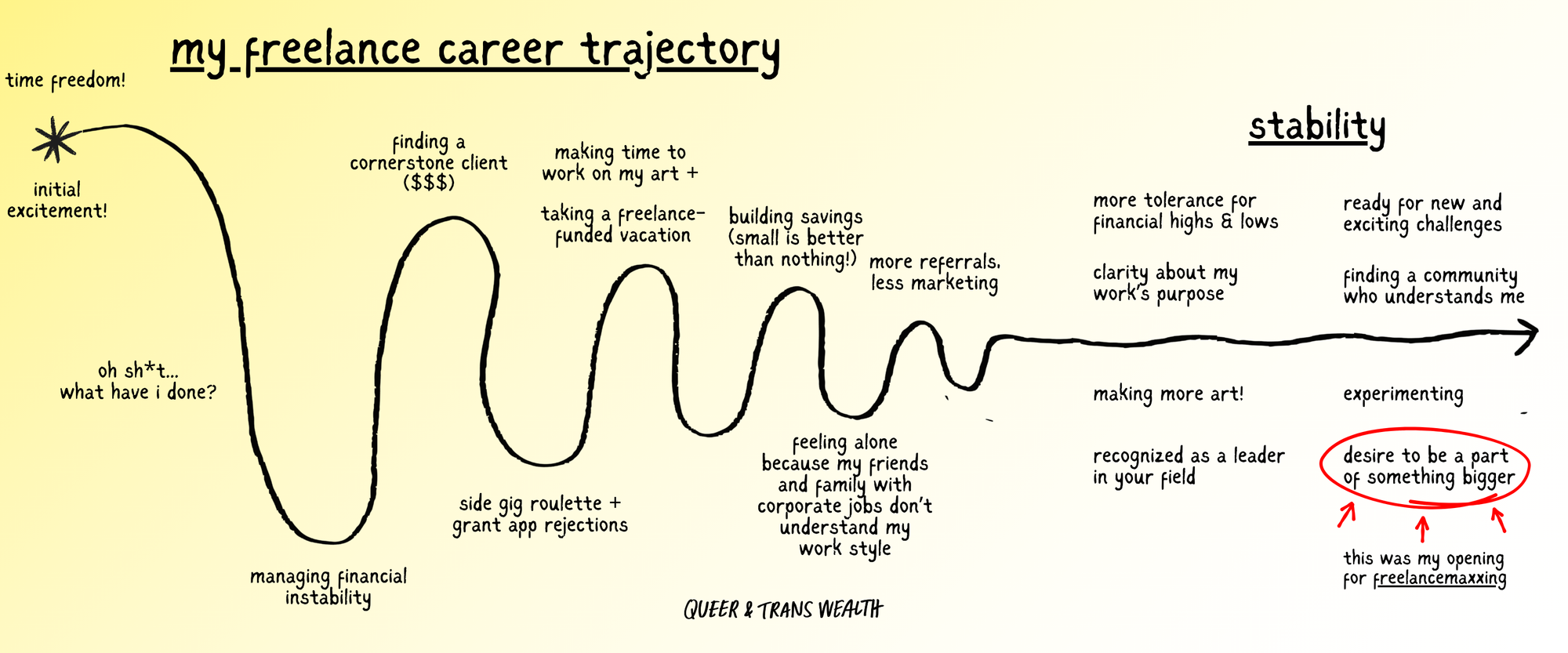
It has taken me months to put this experience into words — and even longer to build friendships and connections with people who are on the same path.
In July, I had the privilege of attending a convening in Berkeley, California called A Better Future is Possible by the Center for Cultural Innovation (CCI). CCI is a nonprofit organization whose mission is to strengthen the economic and social infrastructure for artists, creatives, culture bearers, and creative entrepreneurs. The convening brought together fellow freelancemaxxers who have dedicated their lives to building bold solutions and alternatives to capitalist structures.
In her opening remarks, CEO Angie Kim challenged philanthropic leaders to fund “alternative efforts,” like worker-owned cooperatives and art collectives, which build new economic structures instead of replicating tools that were never designed for freelancers in the first place. Angie added, “We should be trying to thrive, not just be okay with meager fixes.”
The middle school science fair gets a solidarity upgrade
To start the day, CCI set up a “Solidarity Fair” for community leaders who are already championing these new solutions. Similar to a middle school science fair, each community leader had designated space and supportive visuals to talk about their innovative project with other attendees.
Notably, I met:
- Maddy Clifford from the Debt Collective, which organizes student debtors toward the long-term goal of widespread student loan cancellation and free college.
- Sasha Kelley from BLACspace Cooperative, which cultivates an ecosystem of Black artists and culture makers.
- Crystal Huang from the OakTREE Initiative, which is developing community-owned care systems and energy grids in Oakland
- Jessica Mele from the Cookie Jar Collective, which is exploring ways to build collective savings fund for freelancers
It was inspiring to shake hands with people who have endured financial and social risks to build the future worth fighting for. To see these organizations receive both the institutional support and community praise for their work felt sacred. It was like seeing a desert sky full of stars for the first time after leaving a big city with light pollution and just a few distant twinkles — there’s peace in knowing that you’re just one of a thousand stars moving toward a brighter future.
Role-playing solutions
In the afternoon, CCI invited us to role-play situations that require alternative, visionary thinking in finance, energy, and healthcare.
In the finance group, we split up in teams of 10 and brainstormed solutions to the following situation: A large company that provided 25% of jobs announced that it would be leaving our small town. What solutions can the town create to salvage their livelihood? What kind of support does the town need to enact these solutions?
No shade to my group, but I felt that some of the dominant voices among us kept using buzzwords like gift economy and mutualism without acknowledging the cultural differences that make it hard for people of different economic backgrounds to adopt those concepts.
The best plans included time to slow down and honor the transition from an extractive system to a sustaining economy — a countercultural approach to an extractive economy that prioritizes efficiency over basic human needs.
But which gig workers can afford to invest in a better future?
While this convening left me feeling inspired and hopeful, I understood that other attendees saw things differently. At breakfast and lunch, I had the luck of sitting next to a group of cool fashion designers from Cleveland, Ohio. They arrived wearing their own designs, excited to tell people about their artistry. One of the designers told me that she worked as a firefighter to support her creative practice.
Toward the end of the day, I asked how the day’s lessons were landing for the designers. The firefighter-designer said something like, This all sounds cool, but I’m not sure what it has to do with art. When am I supposed to find time to build all of this? From her point of view, economic future-building was a burden that took precious time from her art practice rather than supporting it. Having spoken to other artists outside of this convening who are balancing multiple gigs to stay afloat, this firefighter-designer is not alone in this sentiment.
For artists to invest in alternative solutions, we need some level of financial, emotional, and interpersonal stability. We cannot exercise the courage to build a new economy if we are afraid of losing our housing. We cannot invest in our own future if we’re too busy paying down six-figure student loan debt from art school. We cannot take leaps until a social safety net can protect us during emergencies and failed experiments. With limited resources and capacity, freelance workers cannot do this work alone. We need ongoing institutional support that grants us space to build our future.