

How to start a susu fund 💰
From someone who redistributed $90,000 to BIPOC folks through collective saving

I just finished blurting out one of my fears to my best friends: “I don’t make enough money with this new job. I’m already blowing through my little savings that I managed to put aside. I don’t know what I am going to do”. She asked, “Why don’t you start a susu with some friends?” I was confused since I never heard of the word before.
My friend explained to me that a susu fund is a collective savings method often practiced in West Africa, the Caribbean, and in parts of Asia and Latin America with a different name. In a susu, each member of the fund contributes a fixed amount of money each month, and each member takes a turn receiving the pot of money. Susus are informal, and members agree on a start and end date, so it can last for as long or as short as the members need.
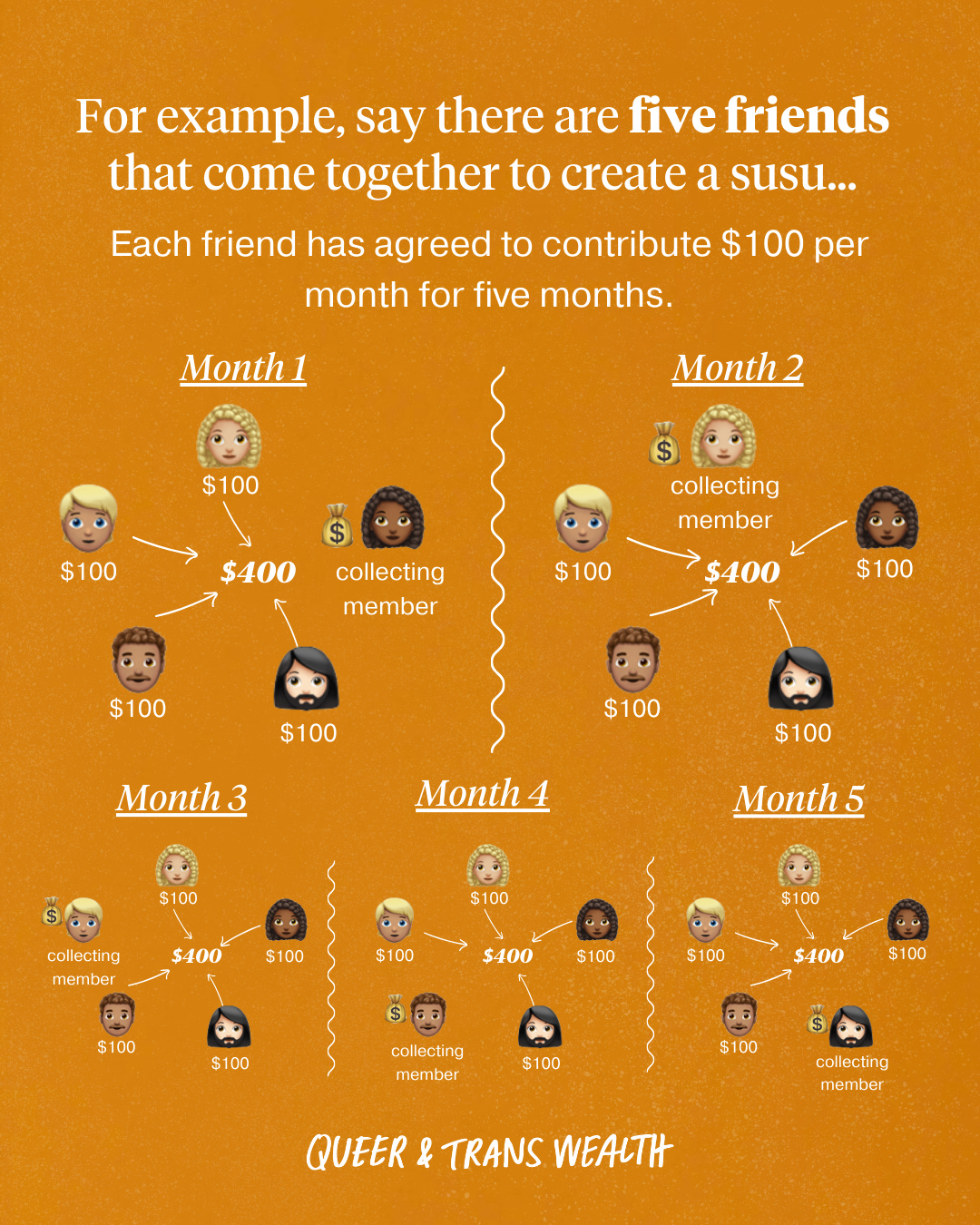
For example, say five friends come together and create a susu. They agree that each person will put in $100 per month for the next five months. That means that one month, one of the friends collects and receives the money from everyone else. Instead of having $100 in their savings, they now have $400. (It’s $400, not $500, because when the person collects, they are not putting in their $100 dollars.)
Subscribe to Queer & Trans Wealth for more anti-capitalist personal finance.
Historically speaking, susus are important because Black and Brown folks were often denied loans from banks. Susus were a way where people could save money and use it to pay for bigger purchases, like paying for their kids’ education, starting a business, or saving for the down payment on a house. Susus became a critical tool for Black and Brown folks to reduce the burden of poverty without having access to banking.
After my friend explained it to me, I said, “Bet. This is Ancestral, and it’s a practice that’s been around for some time.” After much tinkering and wondering, I launched my first Equitable Susu in 2018.
Since then, I have been able to start a savings account that allows me to put some of the susu money aside so when I have regular but urgent needs like car maintenance or an unexpected expense, I can cover it without having to use a credit card.
The Equitable Susu
As I started to reach out to my friends to see who was interested, one suggested making it an Equitable Susu. My version is different from a traditional susu for two reasons:
I don’t receive money, hold it, then divide it up amongst the group at the end. Instead, my susus rely on direct transfers and diligent record-keeping. I assign each member a month during the duration of the susu, and when it’s that person’s turn to receive the payout, everyone sends each other their agreed amount of money using Zelle, Venmo, or PayPal.
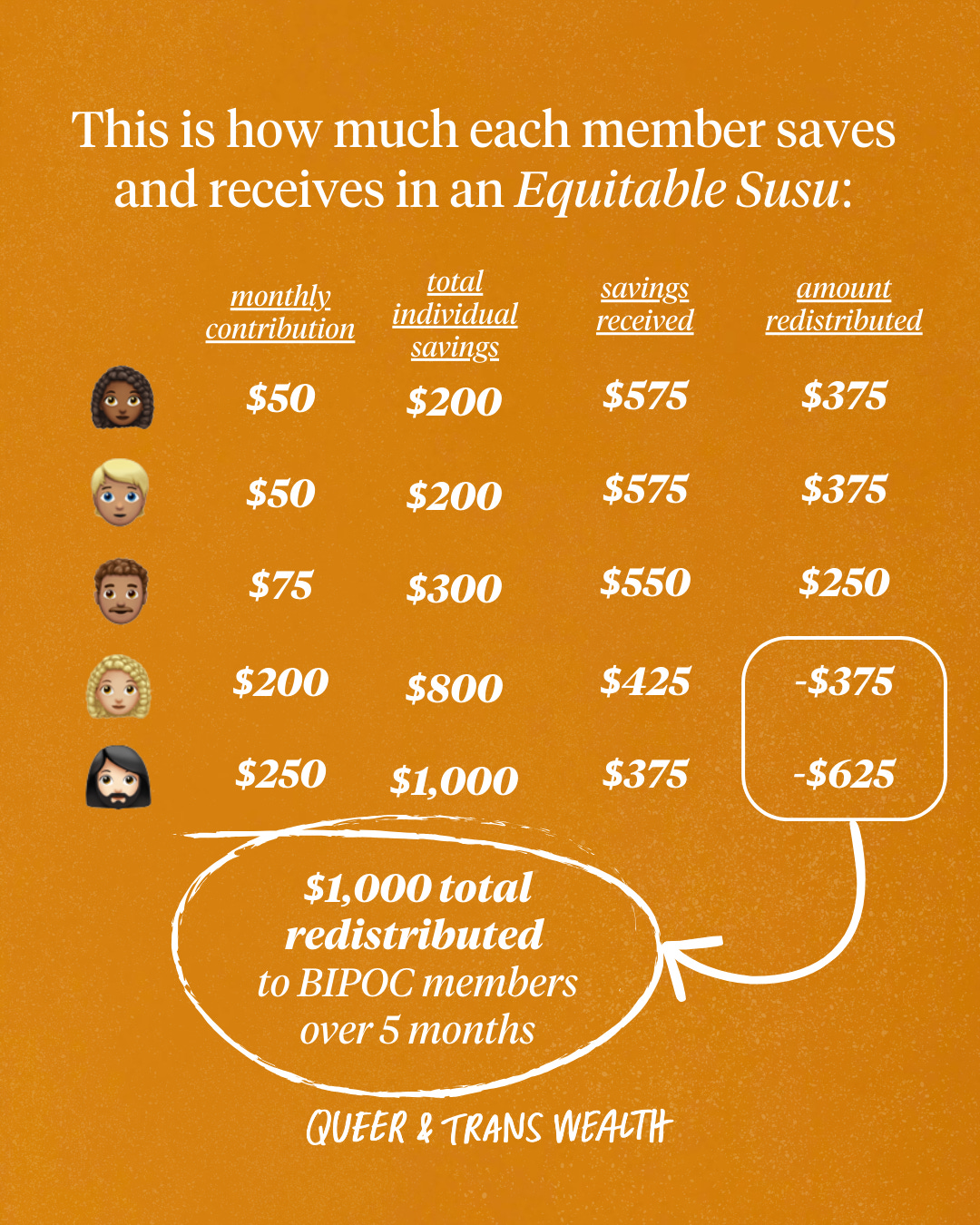
Then, I check in with that person to make sure that everyone sent them their share. We do that process every month until every person in the group collects their susu. Personally, this way felt easier than collecting the money and giving it to everyone when it’s their turn.The Equitable Susu gives members a range to choose from when it comes to their monthly contributions. For example, if you are Black, your contribution can range from $20 to $100. If you choose to put $50, you are committing to put in $50 each month for the duration of the Equitable Susu.
For white people to be a part of the susu, they have to commit to putting $200 or more per month. Since they put in a surplus, that surplus gets redistributed to the Black folks when it’s their turn to receive the susu.
I intentionally wanted Black folks in the group to receive money directly from the white folks. They should be able to choose how to best use that additional money to navigate this world with no questions asked.
How to choose people to start a susu fund with
When I tell people about the Equitable Susu, they get super excited and immediately want to create their own within their communities. While that is great, I also want to make sure I am not romanticizing or minimizing the labor and commitment it takes. When I first started setting up Equitable Susus, I wish I had known that vetting people to join the susu takes a lot of work.
If you’re trying to start your own susu and you want to ask your friends if they’re interested in joining, ask yourself, “Who can I trust?” Who has shown you through their actions that they are reliable, trustworthy, and accountable? I would start there. In that initial conversation, you might have to explain what a susu is and why you want to start one.
More importantly, ask folks what they would need to feel comfortable participating in a susu. Do they need to know what happens if they can’t pay it for one month? What happens if they lose their job? I often find that it’s helpful for systems to be put in place to help with some of those concerns.
This part is extremely important to me since it allows me to make sure that folks are aligned with the values of my Equitable Susu. My vetting process reduces the percentage of one-time participants, reduces the risk of causing harm, and clarifies any confusion that folks might have. I ask folks to fill out a form and get a referral from someone who is in good standing who was or is currently part of the Equitable Susu. In addition to the form and the referral, I also conduct a one-on-one interview with every new person who applies. From there, I make the decision if that person is aligned with our values and how to move forward.
If you have a vision for how you want the susu to run, share that vision with the people you want to start the susu with. Do you know how many people are going to participate? Do you want it to be purely transactional or are you trying to foster a community here?. It’s usually easier to bring someone along if you have a vision, because they can imagine it a bit more clearly than if you invite someone in without a vision.
How to set up a susu fund
Since I’ve started running the Equitable Susu, the number of members who participate has gone from 6 people to 38. Regardless of the size, I still find myself going back to these basic building blocks when setting up my susus:
Do I have a group of people who are ready to go?
These are the people who will contribute to the susu, meaning:
Everyone has filled out the susu form. The form asks:
Their name
Pronouns
How did they hear about the susu?
Why are they interested in joining the susu?
How much can they sustainably and consistently contribute for the next 8-11 months?
The members are aligned with your values. One time, a white woman asked if she could ask what people are doing with the money that she’s “giving.” It was at that moment that I knew she could not participate in the susu because she would have caused harm by asking Black folks how they are using the money that she is “giving” every month. I also knew she didn’t understand one of my key values, which is redistribution, not giving.
Everyone is clear about how much they’re putting in and how long. It’s important to check in with folks, especially if this is their first time. I typically find two patterns merging:
The first pattern is that both Black and White folks want to put in more than what they can afford for different reasons. Black people want to put in more because they want to make sure they are not a burden in the space, benefiting without contributing what they think they should be able to put in. This feeling sits at the intersection of harmful stereotypes that society projects onto Black people. Sometimes, it’s also people’s shame. In these moments, I often hold space and redirect them to making a decision based on how much money they bring in monthly, their budget, and their debt.
When white people want to put in more than what they can handle, it is usually because they are operating for a different emotion — guilt — and they want to move large amounts of money in a short amount of time to ease that feeling. Or, it’s because they are excited about the work and aren’t thinking about the long term. When I run into this, I often find that it is helpful for me to remind folks about sustainability. I ask if this is a number that is sustainable for 10 months. The answer is often no, so that $500 dollars that they were able to do for the first three months becomes $250 for 10 months. I want white folks who participate in the susu to feel like they stretched themselves, but not at the expense of meeting their own needs. Remember, the long-term goal is that they will keep participating in future susus.
Optional but helpful: Schedule a group video call with everyone and have the susu group know who they are in relationship with for the set period of time. This is also a chance for folks to clarify or ask any last-minute questions.
Create a schedule
This is where you decide who is receiving the susu pot and in what order. The two rules I usually use when assigning the months:
Black people will generally go first.
If you are newer to the space, you receive the susu towards the end regardless of your race. It reduces the ability for people to receive the susu and leave without seeing it through.
As people become recurring participants, they will ask for a specific month that they can receive the susu. For example, their birthday month, specific months when they have a surgery or medical procedures, or months that they’re traveling. I try to honor those requests, too.
Once the schedule is created, there’s only one other thing to do: Start the susu!
How to steward a susu fund
Currently, I am the only person who stewards the susu, which means I am making all of the decisions around the fund. I decide:
If and when the next susu will run
How many new people will be able to join
If folks can return and continue to be a part of the susu
In order for a susu to be effective, you have to create opportunities for folks to give feedback. When I tried to bring in Black folks that were out of my immediate network, I got the feedback that setting a $50 baseline contribution was inaccessible to a lot of Black folks. I talked it over with a friend who has been a deep support and thought partner in the Equitable Susu. When she affirmed that sentiment, I lowered it to the baseline contribution to $20.
Aside from being open to feedback, I find it equally important to have peers who can act as a thought partner with you. The growth and sustainability that I have with the equitable susu wouldn’t be possible if it weren’t for my friends and peers holding space and reimagining what a susu can be.
As the steward of the susu, I also have to prep the group to get ready to send and receive the money. For example, if the first person is collecting on January 10, I’ll send out a reminder a week or two in advance, reminding people who to send the money to and which payment apps to use. After January 10, I also follow up with the person receiving the susu and make sure that everyone sent over their share.
✅ Best practices
Start small! While mistakes are a natural part of the process, starting small with some of your closest people will allow you to learn and figure out how to improve it for the next round. The first susu I ran had six people in it and stayed that way for the first year.
Get clear about your values. As you invite folks in, they need to know what you are about and what you stand for.
Trust. You have to trust the people you are asking to be a part of it!
Be open to feedback.
Name the expectation that people will have open communication and reach out to you as soon as possible if folks might need to pay late — especially since the people who are receiving the susu often have plans for how they are going to use those funds.
Come up with an action plan that aligns with your values for when someone can’t pay because of a major unexpected life change, like a job loss, a death in the family, etc.
🚩Avoid
Don’t try and convince folks to be a part of it. You want folks who are eager to be a part of it. Also, some people have been scammed by other “susu’s”, so it might take time for folks to come around. In the meantime, find the folks who are interested!
Avoid running them back-to-back without any breaks. Give yourself a break. It’s a lot of energy, time, and labor.
About the author

Farron is a coach, facilitator, and organizer of wealth redistribution who has been committed to social justice for over 19 years.
They once believed that if they wanted to be in certain spaces they had to compartmentalize themself, but every time they left out parts of themselves it felt like a painful denial of their whole self- it felt like they weren’t acknowledging the reasons why they were able to facilitate, coach, create, vision, collaborate, and execute is because of ALL of their identities, not despite it.
To remedy that, they continuously practice bringing their whole self at all times and is exuberant around supporting other people do the same. Learn more about their work at farronsview.com
In Mexico these are called tandas (singular: tanda) and they are also paid directly to the person whose turn is to collect. Sometimes they even have themes, including plastic surgery – I’ve seen this theme mainly among cis women either with liposuction or breast augmentation, including the commitment to take care of each other post op, sometimes involving other family members/ friends for that part. I wouldn’t be surprised to see trans people organizing a susu / tanda for gender affirming care too.
I’ve never seen the equitable component before though, thanks for sharing.
yep