

Meet your teachers 👋
Sign up for Budgeting for a World on Fire by April 17

Hello to the 5,687 hotties reading this newsletter! Thank you for being here.
ICYMI, Jordan and I are going to be co-teaching a 12-week group coaching program called Budgeting for a World on Fire starting on April 20. You can find more information about registration, scholarships, and payment plans here.
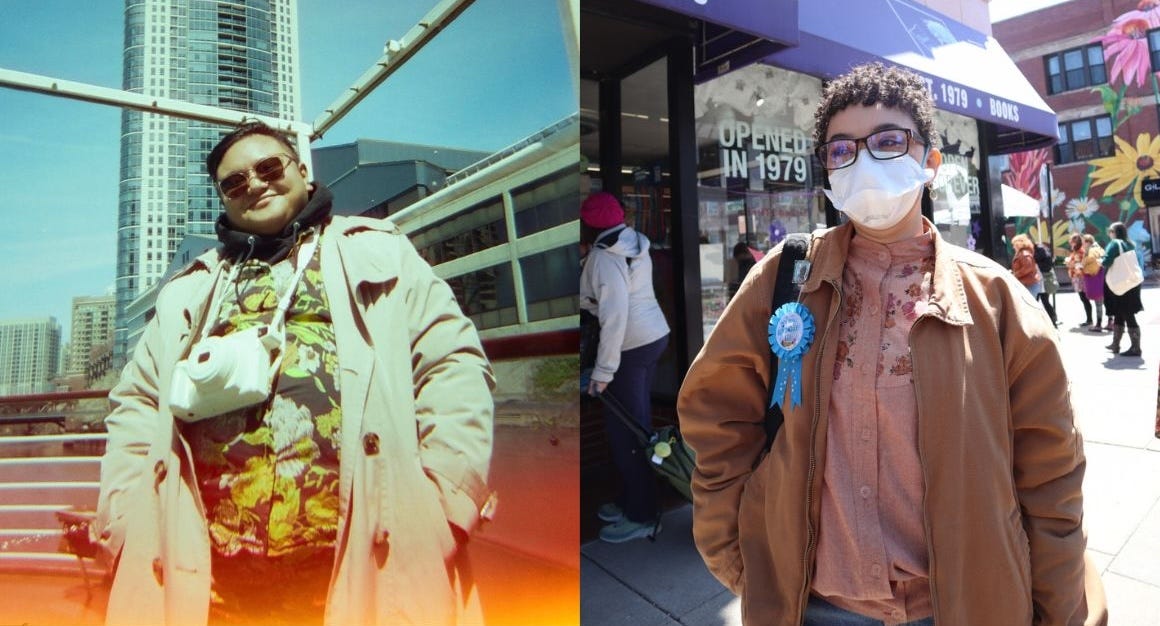
The program is an intimate space, so we want you to get to know us, how we arrive at our work, and what shapes our financial coaching practice.
Shoutout to our creative director, Melba Martinez, for asking the questions!
What attracted you to the work of personal finance coaching?
Jordan: Honestly, as a performing artist, I was taught the narrative of scarcity around finances very early on. And I believed it – initially, I never saw money stewardship as something I could access or something that was for me. But I always questioned why there wasn’t space for artists in financial literacy. I want to disrupt the “starving artist” narrative. I want to empower artists, creatives, and folks with non-traditional income and show them that they are not alone. I want to be of aid in the pursuit of economic justice for those most impacted by systems of oppression.
Leo: In 2020, my grandfather died, and I inherited his journals. A lot of his writing was just a record of what he spent each day, how much he sent home to our family in the Philippines, and writing about whether or not he should take certain side jobs that would compromise his ability to receive government benefits. It was a core-shaking discovery. I am someone who has made every money mistake in the book, and it was so powerful to find some ancestral wisdom about how he was navigating his finances – without fancy apps, Google spreadsheets, or even a warm community to talk to about money. That’s when I realized how transformational money stewardship can be.
Can you share with us what your learning journey around finance has been like?
Jordan: My journey has been many ebbs and flows. My understanding of finance from early on was little to nothing. I learned as I went without really grasping money practices. I was conditioned into a very hyperindividualistic perspective around finance. I internalized the idea that finance is my sole responsibility and any missteps or mistakes made are completely my fault.
Later, I began to recognize that my relationship to money is informed by so much more than just myself. That, in fact, finance is deeply intertwined with systems and structures outside myself. This shaped my journey tremendously and gave me greater context around money. Seeing trauma and finance as interconnected is a major aspect of my learning journey. Today, I can approach finance more intentionally with its origins in mind as I continue to deconstruct what I’ve internalized about finances.
I learned most of my finance knowledge from working in a finance cooperative. It exposed me to a lot of different lived experiences of people and money. Also, taking the Trauma of Money (TOM) course was incredibly eye-opening for me.
Leo: So, I actually remember taking a personal finance class in high school. We had to go to a fake grocery store and balance a checkbook – this was in 2008, btw lol. My earliest memory of money is that math is king. If you have $100 and you spent $105, then a proverbial buzzer goes off, and you’re automatically “bad with money” – or worse, a “bad person” because you overspent.
After graduating from college and getting a salaried job, all that high school training went out the window. And mind you, I had a job that required a lot of math, so I knew I could do math. To me, money didn’t make sense until I started learning the sociopolitical, cultural, and emotional context we all live in.
When I was younger, I spent a lot of time wondering why my family had to leave the Philippines and move to the US, while the rest of my extended family stayed back home. In 2018, I studied Philippine Society and Revolution with members of grassroots orgs Gabriela and Anakbayan.
I learned that the Philippines’ greatest export is labor – as in, overseas Filipino workers (OFWs) leaving our homeland to become nurses, teachers, and tech workers in other countries. It was probably the first time I really took a deep breath and said, “Okay. My parents did their best. I’m doing my best. There’s a larger system at play here.” And that space for self-forgiveness cleared up all the emotional blocks I had around stewarding my money. That’s when things started to click for me.
Like Jordan, I also took the Trauma of Money course! It’s a framework for individual and collective healing from money trauma.
What is one thing you think everyone should know about money?
Jordan: There is enough. There is more than enough. 🫂
Leo: Money comes and goes in waves, and all we can do is learn how to ride the waves 🏄
Why is it important to create a space for queer and trans folks to work on their finances together?
Jordan: It’s important for Queer and Trans folks to work on finances together because we deserve to be in kinship with one another. I believe it’s also important to support each other in having shared lived experience navigating gender oppression. I think affirming spaces to talk about finances are crucial to continue showing up in the work.
Leo: After election day in 2024, I hosted a coworking space for our group coaching participants. Someone wrote me an email that said, “I just wanted to let you know how much it meant to me to just sit with a bunch of queer and trans people today while we silently spent a little bit of time and energy investing in our futures. It was the moment I didn’t know I needed while the future is so uncertain and scary.” That means everything to me!
How are you staying hopeful these days?
Jordan: Pausing more to take in my surroundings.
Leo: Hanging out with my friends and laughing together.