I went to a free Fat Liberation symposium

ICYMI: I am commissioning an essay from a trans writer who fled Kansas, and I’m so excited for y’all to hear their story when it goes live at the end of June.
Right now, I still need to raise $105 to pay the remainder of their writer's fee. If you believe in trans storytelling, please donate here.
Apocalypse spending vol. 5
Every time a medical professional suggests I try Ozempic, I get the heebiejeebies.
I'm the first to admit: I haven't done the scientific research on GLP-1s and semaglutides. My heebeejebies come from the fact that doctors make this assessment before reading my chart, taking any blood tests, or even touching me to conduct any sort of physical exam.
I'm not knocking anyone who's on GLP-1s for legitimate medical reasons. But there has to be something wrong with a drug that doctors prescribe based on a mere look at my fat body.
Last weekend, I had the pleasure of attending a symposium called Fat Liberation in the Age of Ozempic at UC Santa Barbara. Organized by Dr. Caleb Luna, this academic conference featured scholars who study the colonial roots of fatphobia – and create liberatory pathways to combat it. The symposium confirmed my heebiejeebies.
Friends, it was like breathing oxygen for the first time in years. It felt so good to be in a room full of well-dressed fat people who are committed to loving ourselves wholly.
The first panel took place while we were eating breakfast. One of the panelists, Sonalee Rashatwar, invited us to look around. "What does it feel like to be eating in a room full of other fat people?"
We paused the clinking of forks and knives to look around the room. I noticed a sense of relief: I was not worried about strangers judging how much food I am supposed to be eating in public. I relaxed a few muscles that I didn't even realize were strained from that pressure.
I have always been fat, and I will always be fat. Only in recent years did I accept this about myself. And when I did, the world opened up to me. Under the constant spell of weight loss, I spent thousands of dollars on diets, gym memberships, and clothes to fit my body when my weight fluctuated.
On this particular day in Santa Barbara, making peace with my body only cost an investment of time, attention, and $48.
The cost:
- The conference itself was free.
- Most people paid for their own flights and lodging. Santa Barbara is only an hour and a half from where we live, so we didn't need to fly or stay the night.
- Meals were provided, but my partner Melba and I ended up eating elsewhere a few times. Melba paid for gas and meals.
- I spent $15 on donuts and other breakfast items.
- I spent $33 on postcards and a book of stamps from the campus bookstore, for a total of $48 for the whole day.
Regret meter: 0/10
No regrets whatsoever.
A brief summary of everything I learned at the symposium
- From Sonalee Rashatwar and Jules Pashall: I learned that GLP-1s dampen the body’s dopamine system. GLP-1s quiet the excited feeling around food, and lead to a condition called anhedonia, the inability to experience or seek pleasure, which is usually brought on by depression or SSRIs.
Sonalee and Jules theorized that being less likely to seek pleasure and being in a constant state of hunger makes people easier to control by oppressive systems. Both scholars tied the lack of pleasure and desire under GLP-1s to Audre Lorde’s essay, “Uses of the Erotic: The Erotic as Power.” - This was an academic conference, and let me tell you – I am 100% not an academic. I am far too impatient for all the theorizing and studying.
That's why Sydney Griffin's workshop "Directing Fat Action" resonated with me so well. She encouraged us to stop hoarding our knowledge and think: How do we explain the concept of fat liberation to fat people of color who are working minimum wage jobs? To someone who only has five minutes to spare? - SB Pierce, who studies fat girlhood in storytelling, told us about a researcher named Aaron S. Kelly, PhD. Dr. Kelly recently received funding to experiment with twice-daily GLP-1 injections for nine-year-olds.
Yes, the room audibly gasped when we heard about this. - Comic book artist Mollie Cronin shared her incredible comic “Future Me Is Fat,” and I can’t wait to get my little hands on it. She travels back to her 13-year-old self who was obsessed with dieting, then to her future self, who provides more optimism.
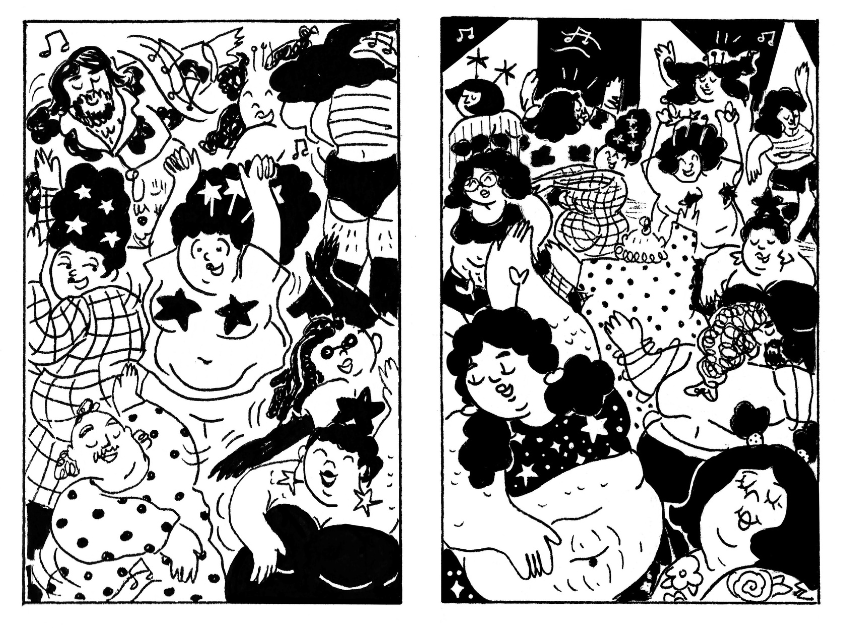
- The biggest treat of the day was hearing excerpts from nonfiction author Da’Shaun Harrison’s latest works in progress. Da’Shaun wrote a book called Belly of the Beast: The Politics of Anti-Fatness and Anti-Blackness. I can’t even begin to summarize the excerpts Da’Shaun shared with us, but it was sooo generous and core-shaking.
Media I’ve been consuming lately:
📖 I'm rereading Hijab Butch Blues by Lamya H. Such a good memoir!
📺 The TV show Bait, starring Riz Ahmed. It’s about a British Pakistani actor auditioning for the role of James Bond. it goes deep, plus Riz Ahmed is sooo handsome, it’s hard to look away. 10/10 highly recommend.
💌 My friend Jasmine Sudarkasa, who once wrote for this newsletter, landed a new job! She wrote about it on her Substack and listed her favorite benefits of being un(der)employed. It was a fun read.
🎥 Boots Riley's I Love Boosters. Keke Palmer's character Corvette plays the leader of a group of professional shoplifters who sell designer clothes at a lower price. The costumes and production design are incredible.
📖 Words Are My Matter by Ursula K. Le Guin. I bought this book in 2021, before a monthlong writer’s residency. I remember feeling so creatively fulfilled, but pressed for time, so I didn’t get too far into the book. Since revamping this newsletter, I’ve been getting that same feeling of creative flow, joy, and trust. It felt like the perfect time to start reading this book again.
Thank you all for your support, and have a great long weekend ahead <3