Meet a queer native tradesworker advocating for their community in the field

I'm a queer native tradeswoman advocating for my community in the field. This is my story.
Nichole Foster's story, as told to Leo Aquino
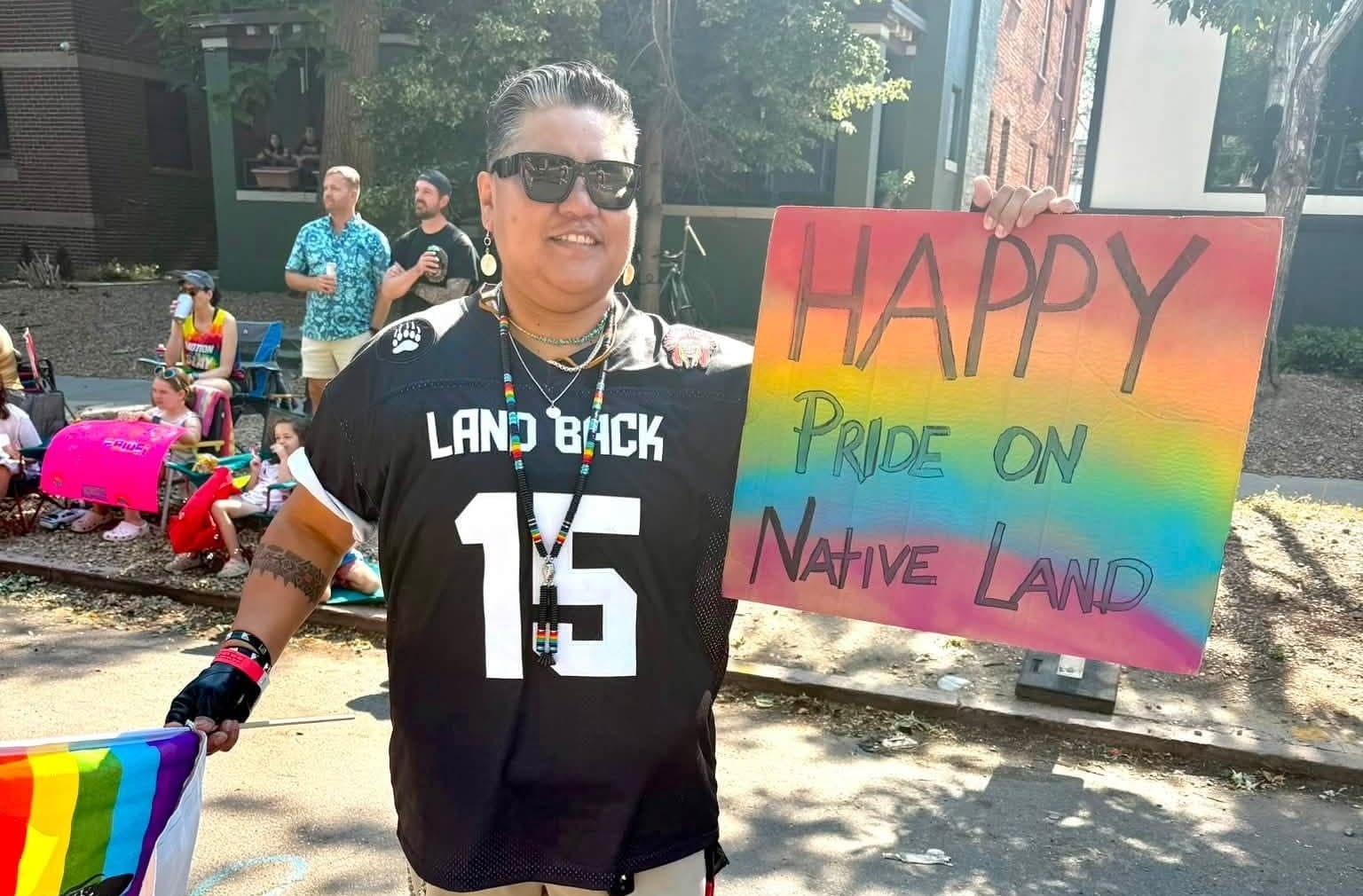
My name is Nichole Foster. I am a member of the Ute Mountain Tribe, located in Southwest Colorado, and I am half Dine’. I live on our sister tribe, the Southern Ute Tribe, with my wife. I identify as two-spirit and use all pronouns. I am a boilermaker and carpenter, who worked on the field between 2015 to 2022. I was a union member of the Boilermaker Local 101 in Denver. Then, I became an organizer who advocates for women, BIPOC, queer and trans, and Native folks in the trades. This is my story.
I am the oldest of five kids. I have two brothers and two sisters, all younger than me. There’s a significant age gap between me and my youngest brother and sister, like 17 and 14 years apart. And then, my other two siblings are two and four years younger than me. Unfortunately, we lost our mother in the early 2000s. Our youngest brother and sister were kids. They were 7 and 19. So me and my other siblings, we pulled together to be there for them. I was an instant parent at the age of 23.
I was working full-time, running a Native youth shelter on my reservation. When I got hired, I was working part-time in the summer, making $9 an hour. I had gotten four promotions, and when I left, I was the acting director. I was still getting paid $9 an hour.
I just got to the point where I’m not able to financially take care of myself or my younger siblings. So on a whim, my sister’s partner at the time was like, “I’m going to welding school! Come with me!” And I said, "Why not?"
Trade school was 12 modules that I finished in about 11 months. As soon as I left school, I was able to find work pretty quickly. But it wasn’t safe work. It wasn’t supported work. They asked us to do a lot, and my cousin and I didn't know that we could say no to things. Unfortunately, working in the trades is very extractive.
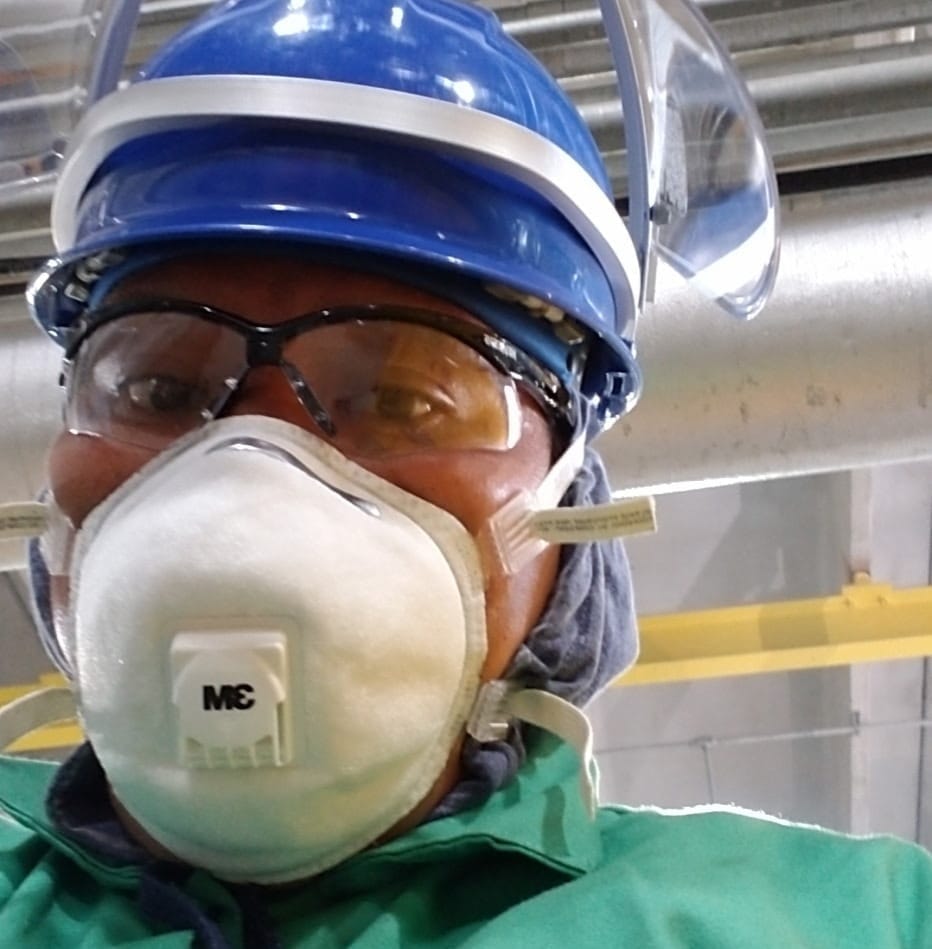
The union kept me safe and helped me build financial stability
My first job, they paid me and my cousin $13 an hour. And for me, coming from $9 an hour, that’s a significant jump, right? But the minimum wage in Denver is $18. You throw on top of that, the type of work that we’re doing. I think around $25 an hour would have been a fair intro rate.
The work didn’t really sustain us for a while. We lived in a hostel for a couple of months, trying to save up money to get an apartment. My finances didn’t really improve until I joined the union about a year and a half later, then I got my first weekly $1,800 check.
When I was in welding school, folks really talked down on unions a lot. I didn’t have a lot of union information. What I heard was, “The unions just want to take your money. They’re corrupt.” So I didn’t go to the union at first.
A lot of the guys that I worked with, they were traveling welders. You can make like $60 to $80 bucks an hour easy. I traveled for a job in Minnesota for three months. On that job, I learned there’s really no protections for people doing non-union work.
You have to buy all of your own equipment. You have to provide all of your own personal protective equipment (PPE). You have to get your own vehicle, the gas, and somewhere to stay. So even though I technically made more money, I was spending more out of pocket.
I was seeing a lot of guys that I work with showing up in their big trucks. They’re spending money every other night. But when they got hurt, and we still have eight months left on the job, they have no benefits. Now his family is gonna have no money until he heals and can work again.
That was a big turning point for me because there’s gotta be something else different out here. So I started exploring my options and found my way to the union. I learned that the union is gonna be responsible for providing your PPE. They’re going to provide the tools. They’re going to provide all the materials. You just show up with your lunch and your readiness to work, then you’re ready to go for the day.
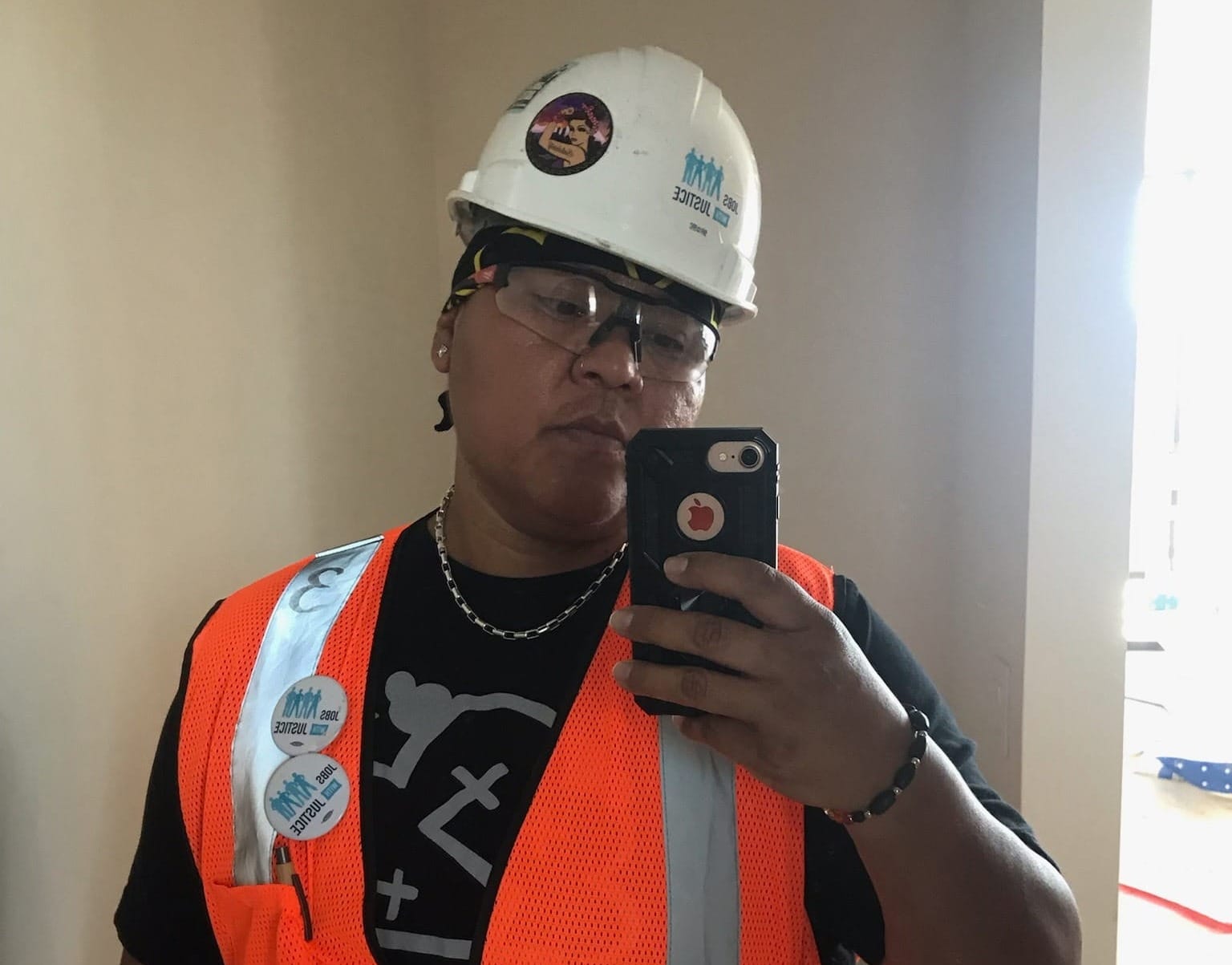
Discrimination can kill you on the job
Unfortunately, there’s not a lot of representation out on the field for women, BIPOC, and queer folks. I had a subcontractor tell me one time, “Everytime you step on a construction site, you have 3 strikes against you. Because you’re a woman, because you’re brown, and because you’re queer.” And that’s exactly right. That did weigh on me for a while, and it was one of the bigger reasons that I ended up leaving.
There were these really well-rounded journeymen, Latinx workers that were fucking phenomenal at what they were doing. We didn’t speak the same language, but they taught me so much. They didn’t care that I was a woman. Then there were these white men who are 24, running the whole entire site.
It was a total imbalance. These 24-year-olds, they had such disdain for me that they ended up throwing me on the roof of a building that we were working. They were like, “You think you’re such a hot shot welder." — really, I'd only said two words since I got there —"You’re gonna go onto the roof and hang these 10x8 panels.” Huge panels that I’m having to hold onto the side of the building and screw in on top. And it was the middle of July. It fucking sucks, but I don’t want to complain about my work.
Finally, I’m like, “Look, if you guys want me to get this done in a timely manner, somebody has to come up and help me.” So for three days in a row, they sent different guys to help me. All of those three guys quit the job every single day, and I’m still up there.
I ended up throwing up on the panels on the roof of that building in July. I ended up getting the worst fucking heat stroke.
At the end of the shift, we were all supposed to meet up, break down and review, make sure everyone’s safe. I didn’t make it because I was still on the roof. I could not climb down that ladder. At some point, I started throwing tools down the hole, because I thought, “Somebody’s gonna hear me.” I thought, at some point, someone’s gonna be like, “Hey, Nichole’s not here. Let’s go find her.” That didn’t happen. I was on that roof for an extra hour, hoping someone would hear me.
Finally, I made it down. My foreman came up to me and started cussing me out. I must have looked horrible because then he stopped and said, “Are you okay? What happened?” I said, “I’m cramping so bad. I still have all my equipment out there. I can’t even think right now.” And he said, “Okay, sit in the shade. Drink some water. And when you’re ready, go back up, grab your stuff, then go home for the weekend.”
And I was like, “What the fuck?” The lack of care was the issue for me. And that was just the end of it. I ended up leaving the trades.
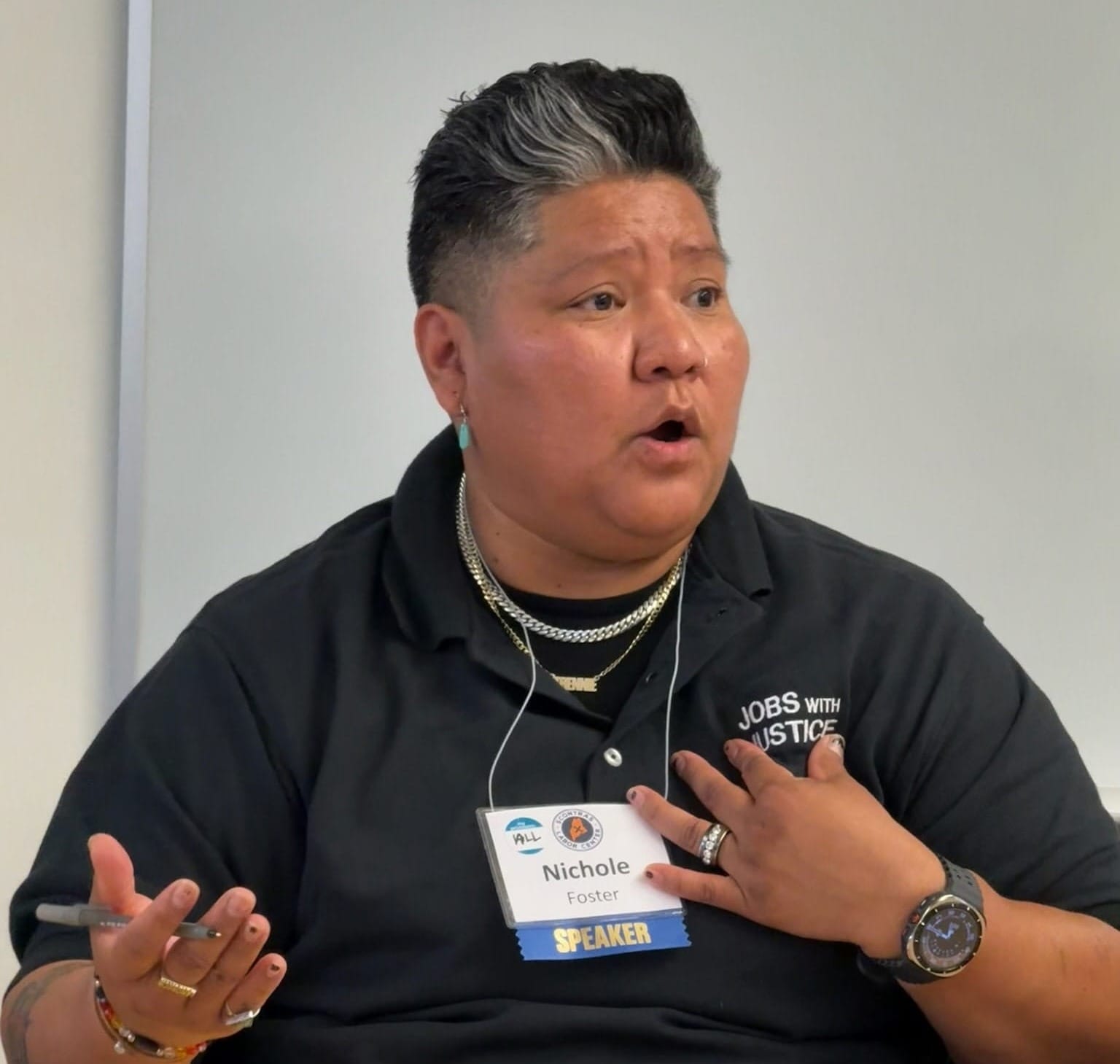
Now I’m shifting culture in the construction industry
I had six months in between leaving the trades and falling into an organizing position within the union. I was talking to someone at a nonprofit organization called Colorado Jobs with Justice, and they were looking for someone to relaunch this program called EPIC, which stands for Equitable Possibilities in Construction. The goal was to recruit women and queer people in the union trades, and make sure they made it in the field all the way until retirement. When you start giving people a small space to be safe, people grow 10 times bigger.
I had learned about a Native tradeswoman that was killed by a fellow construction worker from Arizona. Even though we are the smallest population in the nation, our people go missing and murdered at very high rates. But when it happened to another construction woman, that really impacted me deep down. That story inspired me to start my new organization called, INWIT.
In April, alongside my fellow tradesworker Jessenia Rivera, of the IUOE Local 30 in New York, from the Dine’, K’iche Maya, and Taino tribes, I started International Native Women in the Trades (INWIT). We create support networks so tradeswomen can buddy up with each other while they’re traveling for work. We provide safe space for Native women to talk about what they’re going through and build strategy.
Native women are matriarchs. Native people are stewards of the land. So anything that happens around community, the land, and the women itself, these are places that we need to be. We need to be at every one of these tables, and Native voices need to be upheld.