Solidarity Economy Glossary

The solidarity economy is a global movement that prioritizes the well-being of people and the planet over profit. The solidarity economy movement provides solutions that help us end capitalism and build the new structures that will replace it.
In the past, we've covered personal finance topics like homebuying, paying off credit card debt, and navigating student loans. But we cannot talk about personal financial wellness without addressing the elephant in the room: Our current capitalist economy is broken, and we can't fix it by becoming better at budgeting.
Solidarity economy principles guide everything we create at Queer & Trans Wealth. The definitions below have been harvested from founder Leo Aquino's studies with Economics for Emancipation, Next Economy MBA, the Trauma of Money Institute, and Anticapitalism for Artists.
Tips for using this glossary:
- Click the arrow on the top right corner of the box to read a word's definition. We formatted the glossary this way to prevent overwhelm and help you focus.
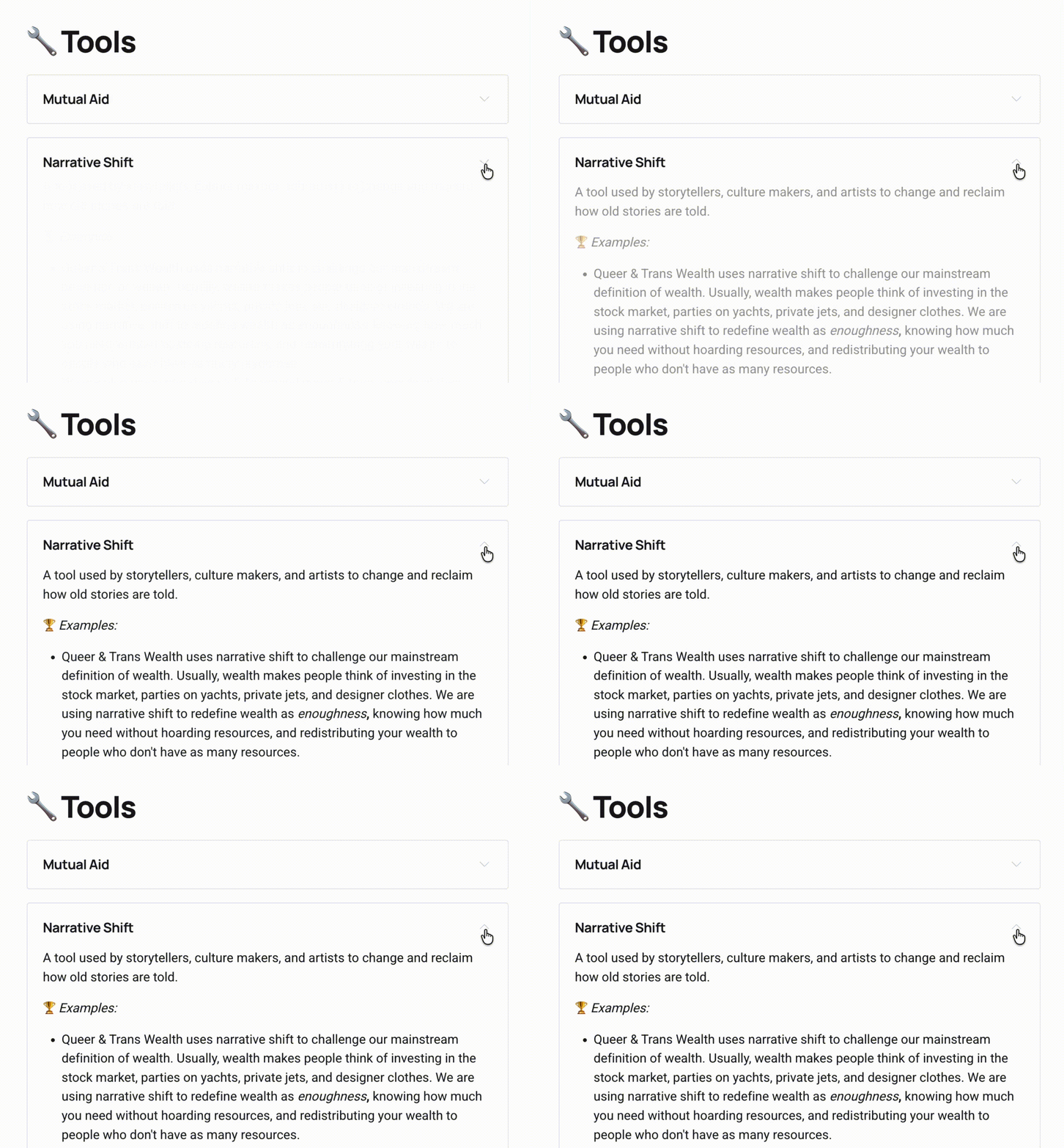
- Any stories we've written that are related to the words and concepts are linked under the definition.
- Use Ctrl + F (Windows) or ⌘ + F (Mac) to search for specific words
🧠 Concepts
Circular Economy
An economy designed to eliminate waste by prioritizing reuse and repair. Instead of throwing products away, circular economic models find ways to take things apart and reuse the materials for another purpose.
🏆 Examples:
- Volunteers who set up repair cafes help people in their local community repair electronics, appliances, gear, clothes, or other home goods instead of throwing those items away.
- Thrifting clothes and other items instead of buying brand new items.
- Buying refurbished electronics instead of new ones.
🗯️ Caveats:
- The term circular economy was coined by white men in the 90s. But Indigenous communities have been practicing circular economy for centuries.
- While repairing, refurbishing, recycling, and reusing materials cut down costs in one area, this practice requires a heavy labor investment. This makes products from circular models more expensive and less profitable.
- Materials lose quality, strength, and purity over time, plus recycling materials may require more electricity and water in the long run.
Gift Economy
A system of exchange where goods and services are given without any expectation or reward. The giver gives because they have an excess, and they do not expect anything in return. The receiver is encouraged not to feel guilty for taking the gifts. In theory, there is no hierarchy between the giver and the receiver.
🏆 Examples:
- Since 2008, Los Angeles organizers have been putting together an event called Dyke Day using the gift economy. In contrast to Pride events that cost hundreds of dollars to attend, Dyke Day is run completely by volunteers and donations to provide a safe space to celebrate Pride.
- Local communities organize Buy Nothing Groups where neighbors can give away unneeded household goods, furniture, or clothing for free.
- Some neighborhoods have Little Free Pantries or Libraries where neighbors can access free resources.
🗯️ Caveats:
- Tragedy of the commons: Inevitably, one person may take more resources than they need, or break the mechanisms that allow people to get things for free. In her book The Serviceberry, Indigenous botanist and author Robin Wall Kimmerer told a story about a neighborhood farm stand that helped farmers share their excess fruits and vegetables. Someone took the wood planks that made up the structure of the farm stand. It's unclear whether that person misunderstood the sign that said "Free Farm Stand," or if they took the wood for nefarious reasons. Either way, the farm stand couldn't continue because of their actions.
📝 Related stories:
- 7 lessons from dyke economies, the stories of Jewel Thais-Williams and Dyke Day LA by Leo Aquino
🤲 Notable thinkers:
- Robin Wall Kimmerer, Indigenous botanist and author who writes about gift economies in the natural world
Just Transition
A strategic framework that helps us move from a capitalist economy to a solidarity economy. We will not move from our broken economy to a new one overnight. This work requires small, strategic, and organized efforts to help us resist oppressive systems and build regenerative systems.
As of October 8, 2026, QTW is still pulling examples and caveats for this concept.
Regenerative Economy
An economic system that actively revitalizes, restores, and repairs natural resources and communities instead of depleting them. Though the term 'regenerative' is usually associated with environmental justice efforts, 'regenerative' can also be applied to interpersonal and community relationships.
🏆 Examples:
- Instead of cultivating one fruit or vegetable forever, farmers may diversify their crop rotations to preserve the health of the soil. Monocropping depletes the nutrients in the soil and makes farmland unusable over time. For example, a strawberry farmer with a network of grocery stores might have to turn away potential sales to diversify crops and restore the soil.
🗯️ Caveats:
- Greenwashing: Brands and corporations may use the term 'regenerative' as a marketing tool to sell products — even if those products do not fall under that category.
🔧 Tools
Mutual Aid
Writer Dean Spade's definition: Collective coordination to meet each other's basic needs out of an awareness that existing systems are failing or making things worse.
🏆 Examples:
- Jane requires gender-affirming surgery, but she doesn't have health insurance. Her friends pool $25,000 worth of mutual aid over 8 months to help her pay for surgery and take care of her after the surgery.
- The Black Panther Party Free Breakfast Program provided free meals to thousands of school children and ran free health clinics. Though the program inspired public schools to provide free meals to children in need, the Black Panthers faced institutionalized racism and warfare when the program first started in 1969.
🗯️ Caveats:
- There's a popular saying in social justice spaces that we're all just passing around the same $5. GoFundMes and meal trains do not fix institutional problems that restrict widespread access to food, healthcare, housing, and other resources.
Related stories
- I believe in mutual aid. I also believe in having enough for myself to be well. by Bunnie McKensie Mack
Narrative Shift
A tool used by storytellers, culture makers, and artists to change and reclaim how old stories are told.
🏆 Examples:
- Queer & Trans Wealth uses narrative shift to challenge our mainstream definition of wealth. Usually, wealth makes people think of investing in the stock market, parties on yachts, private jets, and designer clothes. We are using narrative shift to redefine wealth as enoughness, knowing how much you need without hoarding resources, and redistributing your wealth to people who don't have as many resources.
We are also using narrative shift to remind queer & trans people of their inherent wealth: We are wealthy when we can exercise autonomy over our time, labor, and bodies. We are wealthy when we prioritize our humanity and relationships over profit and burnout.
🗯️ Caveats:
- Narrative shifts are not short-term marketing campaigns. Narrative shifts require deep, sustained, multi-year investments instead of quick fixes.
Non-Extractive Lending, or Regenerative Financing
Under capitalism, lending money is a profitable, extractive business. Lenders charge interest rates that affect the borrower's ability to thrive and keep the fruits of their labor for themselves.
For example, if a credit card company lends you $20,000 for a medical emergency with a 30% annual interest rate, you will pay $6,000 in interest if you pay your balance within a year, and the lender will earn $6,000 in profit. You could have saved that $6,000 instead to avoid going deeper into debt when faced with another emergency.
Non-extractive lending is a practice that ensures that the borrower is never left in worse condition than when they first received the money. Usually, this means offering loans with a 0% interest rate and flexible terms. This practice is also referred to as regenerative financing.
🏆 Examples:
- Most cities have a Hebrew Free Loan Society, which offers 0% interest loans to help people start businesses or pay back high-interest debt.
- Seed Commons is an organization that gives low-interest loans to worker-owned cooperatives all over the United States. Seed Commons does not collect loan payments until the co-op is profitable.
🗯️ Caveats:
- It costs money to administer non-extractive loans. If there's $100,000 raised from wealthy donors or philanthropic organizations for non-extractive lending, a portion of that money is allocated to the administration of the loans, i.e., emails, invoices, and legal paperwork.
- Administrators absolutely deserve to get paid well for their labor. But additional clerical and legal hurdles make it harder to move money to people who need it quickly.
✍️ Related stories:
Open Source
Information, data, knowledge, or software accessible to the public so that anyone can use, study, modify, or share it without legal limits, such as intellectual property laws.
🏆 Examples:
- Ghost is an open-source content management system platform that allows small businesses like ours to publish content regularly. Ghost's entire source code is distributed under a permissive license, which makes it easier for publishers to create their own layouts and pages within their site. Unlike major CMS companies like Substack and beehiiv, Ghost is a nonprofit organization.
- Wikipedia is a massive global database that is collaboratively edited by people all over the world.
🗯️ Caveats:
- Open source information may contain inaccuracies.
- Open source ≠ free. You'll see that Wikipedia is always raising money and Ghost charges annual fees. It costs money to make the information, data, or software available.
Participatory Budgeting
A democratic process where members decide how to spend a portion of a public budget.
🏆 Examples:
- Participatory Budgeting started in 1989 in Porto Alegre, Brazil, as an anti-poverty measure that keeps government corruption in check.
- In New York City, there's a project called The People's Money under the Civic Engagement Commission that lets New Yorkers vote on how a pool of money is spent.
🗯️ Caveats:
- This process requires a strong organizational team that keeps records, facilitates meetings, and presents proposals.
- This process requires a lot of time from local community members. People who are working two or three jobs won't be able to invest the same amount of time as someone who works part-time with the support of their spouse and passive income from investments.
Sliding Scale or Reparative Pricing
To make goods and services more accessible, business owners offer prices on a sliding scale. The lower prices are reserved for low-income folks who cannot afford to pay full price, while the higher prices are for high-income folks who can afford to pay more to subsidize lower payments.
🏆 Examples:
- A therapist may offer sliding-scale or reparative pricing for their services, ranging from $50 to $300 per hour. If they only charged $300 per hour, their clientele would be limited to wealthy people who can afford to pay $300 per hour.
If they charged only $50 per hour, that therapist might have to work 60-70 hours per week to cover basic expenses. Offering a sliding scale prevents burnout while allowing access to people of all income levels.
🗯️ Caveats:
- Lower-income clients tend to pay a lot more because they feel guilty for underpaying. Higher-income clients tend to pay a lot less because they are under a scarcity mindset.
- Offering reparative pricing requires deeper conversations during the sales process to ensure that people are paying a fair price that they can actually afford.
Time Banks
Community members come together and trade their time, hour for hour, to meet their basic needs.
🏆 Examples:
- In Japan, there are groups of millennials and Gen Xers who have formed a time bank for elder care. They take turns taking their elders to doctor's appointments, cleaning their houses, or helping them sort through their mail.
🗯️ Caveats:
- People who participate in time banks have to agree that their services have equal value. If a lawyer and a gardener happen to be in the same time bank and they agree to exchange services, the lawyer and gardener both have to agree that their services have equal value. It may take time for people to unlearn these capitalist norms. Most time banks focus on exchanging the same types of services to avoid this conflict.
Wealth Redistribution
The transfer of income, money, or property from wealthy people to poor people. Methods include tax reform, philanthropy, and direct giving.
🏆 Fictional examples:
- A wealthy person whose family made a fortune from gentrification decides to redistribute 90% of their wealth to local rental assistance programs.
- A wealthy person whose family made a fortune from gentrification decides to sell their rental properties to their tenants below market rate.
- A wealthy person whose family evaded taxes decides to pay the fair tax rate. Their taxes allow local schools to increase their budget for books and computers.
- A wealthy person whose family made a fortune from student loan interest decides to redirect their profits to scholarships.
🗯️ Caveats:
- Sometimes, people will use wealth redistribution as a way to gain good press after committing horrific crimes against humanity. For example, the Sackler family redirected massive profits from selling OxyContin to funding museums. They clearly made these donations to clean up their reputation after playing a major hand in the opioid crisis.
🏢 Structures
Collective
A group of individuals who share resources and knowledge.
🏆 Examples:
- Queer & Trans Wealth is a member of the Tiny News Collective, which provides resources for news and media entrepreneurs. Through the collective, we receive monthly workshops and opportunities to connect with other small businesses. We are also fiscally sponsored by the Tiny News Collective. That fiscal sponsorship allows us to receive grants and donations.
- Artists form collectives to achieve shared political, financial, or social goals. Artists for Palestine UK was formed in 2015 to gather collective support for Palestinians.
🗯️ Caveats:
- Collectives need strong leadership and protocols to determine how decisions are made.
Community Land Trust (CLT)
Land and buildings placed in a trust owned by a nonprofit organization to secure affordable rent for residents.
🏆 Examples:
- In New York City, the Cooper Square Community Land Trust was founded in 1959 when politicians in charge threatened to demolish their housing and sell the land at a discount to real estate developers. The CLT organized for decades, advocating for their right to affordable housing in their neighborhood.
In 1990, the city of New York transferred buildings in deplorable condition to the Cooper Square CLT for rehabilitation. The renovation resulted in 328 renovated housing units in 21 buildings — all sold at affordable prices to residents.
🗯️ Caveats:
- It's a long game. It can take decades for a city to transfer land to the CLT and raise the funds needed to renovate or build new structures.
Community Supported Agriculture (CSA)
A food distribution model where customers buy a farm's harvest before its production. This model gives farms the startup funding required to plant and care for vegetables and fruits. The customers pay a monthly fee and typically pick up their CSA order in person.
🏆Examples:
- In Los Angeles, Black Thumb Farm offers a CSA box of vegetables and flower bouquets in the summer. Black Thumb Farm teaches local youth how to grow and sell vegetables.
🗯️ Caveats:
- The produce box tends to be more expensive than shopping at the grocery store.
- You pay before you know what the harvest looks like. You can't predict what produce you'll get. If the farm did not harvest enough vegetables, it's possible that you'll get very little or no produce at all.
Debtor Unions
A group of people who owe debt to the same company who fight for fair terms and loan forgiveness.
🏆 Examples:
- The Debt Collective is a group of student loan debtors who are fighting for widespread student loan forgiveness and free college. Famously, the Debt Collective started a debt strike for graduates of Corinthian College in 2015. These debtors refused to pay back their loans because Corinthian College targeted low-income students and lied about job placement rates. The debtors won complete student loan forgiveness and set a precedent for other predatory schools.
🗯️ Caveats:
- If your debtors' union decides to stop making payments, individual members' credit scores will be damaged. A lower credit score prevents people from buying homes, renting apartments, and making other large purchases that require a credit check.
Labor Unions
A group of workers who work at the same organization or in the same profession to fight for fair pay, benefits, and protections in the workplace.
🏆 Examples:
- The California Teacher's Association has 310,000 members who advocate for better working conditions in California. Under the Teacher's Association umbrella are smaller groups, like United Teachers Los Angeles with over 35,000 educators.
🗯️ Caveats:
- The inclusivity of unions depends on their stewardship. Let's say a queer teacher was facing discrimination in the workplace. If their union steward dismisses their claim, the queer teacher now has to fight their school and the union to get their needs met.
- Unfortunately, union politics mirror the biases of the general public. It's harder for people of color and queer and trans people to gain respect of their peers and advocate for their rights.
✍️ Related stories:
- Should queer and trans people work in the trades? by Leo Aquino
- Meet a Native tradesworker advocating for their community in the field: Nichole Foster's story as told to Leo Aquino
Susu Funds
A practice where a number of people put money in a pot, and then everyone in the group takes turns collecting the pot of money. Originated in West Africa. Different cultures have their own version: Tandas in Mexico, Partners in Jamaica, and Kitties in India just to name a few.
🏆 A fictional example:
- Five friends decide to each put $100 in a susu fund each month.
- Each friend takes a turn collecting $400. (The friend collecting the money doesn't put in $100 during their turn, which makes the total $400 instead of $500.)
- At the end of the five months (one month per friend), the group decides if they want to continue the practice.
🗯️ Caveats:
- The person stewarding the money could simply run away with the cash. In 2020, people of color reported getting scammed by others who collected cash and ran away with it.
- Susu funds run on trust. You should only join a susu with people that you absolutely trust.
✍️ Related stories:
Tenant Unions
A group of tenants who live in the same building, neighborhood, or city, who organize to get their landlords to repair their buildings, improve amenities, stop rent increases, and stay in their buildings when landlords try to sell properties to turn a profit.
🏆 Examples:
- When landlords want tenants to leave, they take away essential amenities like parking spots, or they stop repairing your unit and the building as a whole. Their goal is to make it as uncomfortable as possible for you to live there so that you leave voluntarily. After you leave, they will repair and renovate the building and rent it at a higher rate. In Los Angeles, when folks start noticing these shady landlord tactics, tenants can turn to the Los Angeles Tenants Union for support. LATU has groups specific to each neighborhood in Los Angeles.
🗯️ Caveats:
- Because labor unions are legally protected under the National Labor Relations Act, employers are required to negotiate with workers in good faith. In contrast, tenant unions are not legally protected. Landlords are not legally obligated to negotiate with tenants. Wins are hard-fought and rare for tenant unions.
Worker-Owned Cooperative
A cooperative is a business that is co-owned by the people who work at the company.
In a traditional for-profit company with a CEO, workers generate the profits, but most of it lines the CEO's pockets. In a worker-owned cooperative, workers split the profits equally.
Non-profit organizations may operate as a worker-owned cooperative, too, by practicing collective decision-making over their time and impact.
🏆 Examples:
- After getting laid off from Eater, a couple of writers got together and started a worker-owned food media company called Ravenous. In May 2026, they raised nearly $100,000 through a membership drive to support their daily operations.
- Founded in 1990, AK Press is an anarchist publishing and distribution company owned by its workers. AK Press has published books by adrienne maree brown, Marlon James, and Cynthia Rankine.
🗯️ Caveats:
- Compared to a traditional company with a CEO, co-ops have to spend more time establishing governance and bylaws. Some co-op leaders have said that the time spent in meetings negotiating workload and ethics could have been spent making products or offering services that generate revenue.
Update Tracker
- This guide was originally published on October 8, 2026.
We will track changes and updates to the glossary in this widget. If you have any corrections or suggestions, please email us at hello@queerandtranswealth.org 💌